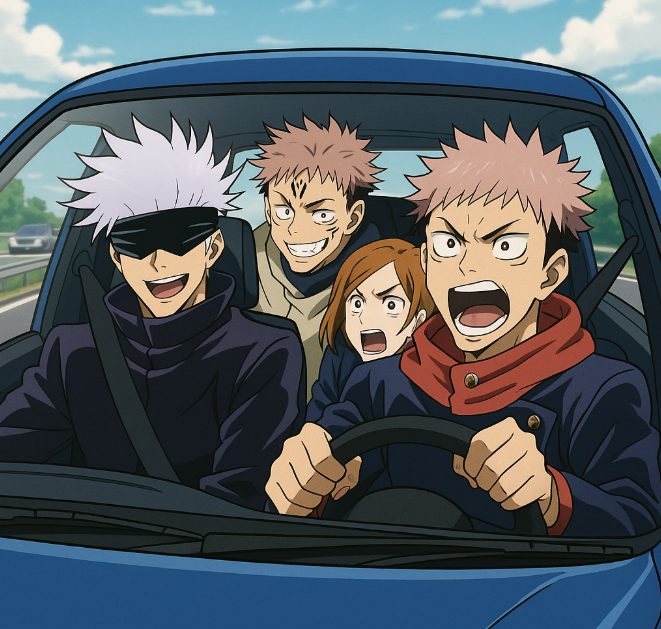
If you’re deep into Jujutsu Kaisen, you already know the pattern: a calm moment, a sudden curse attack, and then total chaos. Buildings collapse, streets crack, and characters like Gojo or Sukuna turn entire districts into battlegrounds. The Shibuya arc alone feels like a long lesson in destruction, impulsive decisions, and “I’ll deal with the consequences later.”
That energy is perfect for anime. It’s not so perfect when you’re holding a driver’s license.
You can scream at the screen during Gojo vs. powerful curses, cheer Yuji when he jumps into danger, and rewatch your favorite fights a hundred times. But once you touch a steering wheel, you’re not in a shōnen battle anymore—you’re in a world with traffic laws, repair shops, medical bills, and insurance companies.
In this article, we’ll use Jujutsu Kaisen as a fun way to think about risk, responsibility, and why real-world drivers—especially new car owners—need both smart behavior and solid financial protection.
When JJK Characters Act First and Think Later
A big part of JJK’s charm comes from its characters’ reckless courage:
- Yuji Itadori throws himself into fights if it means saving someone.
- Nobara Kugisaki refuses to back down, even when she’s clearly outnumbered.
- Satoru Gojo treats world-level threats like casual training exercises.
- Sukuna? He doesn’t even recognize the concept of “consequences.”
That’s great storytelling—but imagine these personalities behind the wheel:
- Yuji flooring the gas “just this once” to see how fast the car can go.
- Nobara swerving aggressively because “I’ve got this under control.”
- Sukuna weaving through traffic because rules are for other people.
In the anime, those choices lead to epic slow-motion shots and dramatic soundtracks. In real life, they lead to tickets, accidents, and legal and financial disasters.
From Cursed Battlegrounds to Real-World Roads
In Jujutsu Kaisen, a destroyed street is just the backdrop for the next episode. No one shows Gojo filling out accident reports or Sukuna negotiating with a mechanic. In our world, every dent, scratch, and crash has a price.
Here’s a simple comparison:
| JJK Situation | What Happens in Anime | Real-World Equivalent | Real-World Consequence |
|---|---|---|---|
| Gojo levels half a battlefield | Looks awesome, no bills, no paperwork | You cause a multi-car accident on the highway | Massive repair costs + possible lawsuits |
| Yuji jumps in without a full plan | Gets hurt but pushes through with willpower | You speed in heavy rain “just this once” | High accident risk, higher premiums |
| Sukuna destroys anything in his way | “That’s just Sukuna being Sukuna” | You drive aggressively and tailgate | Tickets, points on your license, higher rates |
| Sorcerers tank damage with cursed energy | Walk away from devastating impacts | You rely only on “I’m a good driver” | One mistake can cost thousands of dollars |
Anime gives you the fantasy of infinite stamina and plot armor. Real life doesn’t. That’s why smart drivers combine calm decisions with protection that actually works when something goes wrong.
Why Even Responsible Drivers Need a Safety Net
Maybe you’re nothing like Sukuna on the road. Maybe you:
- Respect speed limits
- Avoid your phone while driving
- Keep your car maintained and insured
Even then, you’re not immune to “curses” like:
- A distracted driver hitting you at a red light
- A storm dropping a branch on your parked car
- A hit-and-run leaving your bumper wrecked
Car insurance is basically your real-world barrier technique. The right policy can help cover:
- Repairs after an accident
- Medical bills if people are injured
- Liability if you’re at fault for damage or injuries
And if the cost worries you, there are flexible ways to set things up. Some drivers benefit from low down payment policies, which make it easier to get covered without needing a huge amount of cash up front. If you’re curious how that works in practice—how deductibles, coverage limits, and payments can be tailored to your budget—it’s worth looking at a detailed guide on the customization of low down payment auto insurance.
Building a “Sorcerer-Level” Plan as a New Car Owner
In JJK, the strongest sorcerers don’t survive just because they’re powerful—they prepare. They gather intel, understand their enemy, and think several moves ahead.
New car owners should approach money the same way. Buying or financing a car is just the start. You also have to handle:
- Insurance premiums
- Fuel
- Maintenance and unexpected repairs
- Parking or garage fees
- Registration, taxes, and inspections
If you rush into car ownership like Yuji rushing into a fight, your budget can get cursed fast. A few surprises—like a sudden repair, a premium increase, or a ticket—are enough to ruin a month’s finances if you haven’t planned ahead.
That’s why financial planning for new car owners is so important. It’s not just about “Can I afford the payment?” but “Can I afford to keep this car running and properly protected over time?” For a structured look at how to budget for ownership, insurance, and emergency costs, a resource dedicated to financial planning for new car owners can help you build a realistic, long-term strategy.
Practical Checklist for JJK Fans Who Drive
You don’t have to stop loving insane battles and total destruction on screen. You just have to make sure your real-life decisions look more like a well-planned strategy than a last-second domain expansion.
1. Keep the chaos on the screen
- Enjoy the Shibuya Incident arc—but don’t copy that energy on the highway.
- No “testing your limits” with speed or risky lane changes.
2. Treat your car like a long-term mission
- Schedule regular maintenance: brakes, tires, oil, lights.
- Fix small issues early so they don’t evolve into boss-level expenses.
3. Choose insurance that fits your actual life
- Think about your commute, parking situation, and driving habits.
- Decide whether a low down payment helps your cash flow or just delays costs.
- Make sure your coverage limits are enough to protect you from worst-case scenarios.
4. Plan your budget like a strategist
Here’s a simple framework you can use:
- Monthly basics:
- Loan/lease payment
- Insurance premium
- Fuel
- Occasional but predictable:
- Oil changes and routine maintenance
- Registration and inspections
- Unpredictable but inevitable:
- Repairs
- Deductibles after a claim
Setting aside even a small “car emergency” fund can turn a random bad event into something you can handle without panic.
5. Respect real-world “curses”
In JJK, curses show up suddenly and hit hard. On the road, curses look more like:
- Distracted drivers
- Bad weather you didn’t plan for
- Mechanical failures at the worst possible moment
You can’t control everything. But you can control how well prepared you are—with cautious driving, realistic budgeting, and enough coverage to keep one accident from turning into a long-term financial wreck.
Final Thoughts: Enjoy the Fights, Drive the Opposite
Jujutsu Kaisen is awesome precisely because its world is so intense and exaggerated. Characters gamble with their lives constantly. Consequences are emotional and dramatic—but not financial.
In our world, the “villains” are repair bills, medical costs, and legal liability. Your best move isn’t acting like a fearless protagonist—it’s driving calmly, planning your money, and setting up protection so that if something does go wrong, you’re not ruined.
So, binge your favorite arcs, cheer for your favorite characters, and analyze every fight frame by frame. Just remember: when you close the streaming app and pick up your car keys, leave the cursed energy in the anime. In real life, the strongest technique you can use is simple: drive with a clear head, and make sure your finances and insurance are set up to protect you when you need it most.
